Tom Hiddleston on Tenzing, the Life-Changing Impact of Loki and Why Fatherhood Is His “Most Important Role”
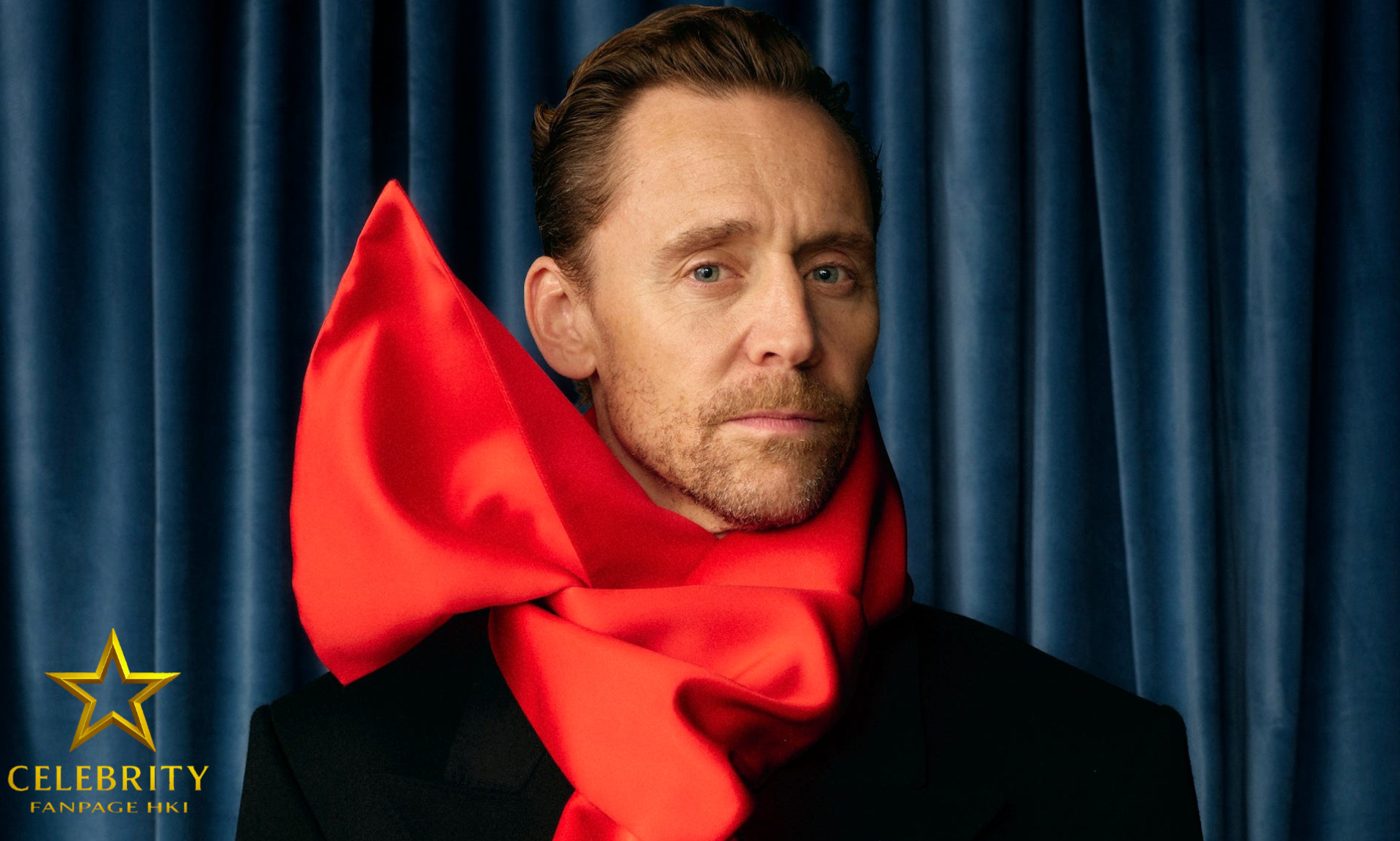
Magnetic, erudite and unfailingly affable, the British actor has commanded stages and screens from London to LA

This is what I see: a black screen, a flash of light and then his face. Smiling, handsome. Sunlit, because he is in Los Angeles where it is the early afternoon. This is what he sees: a black screen, a flash of light and then my face. Smiling, a little twitchy after an espresso. Lamplit, because I am in London where it is midnight.
“Can I just start,” he says, “by thanking you for staying up so late to speak to me? That is above and beyond.”
Thanks to the scheduling complications of movie-promoting and magazine-making, the only time Tom Hiddleston and I can talk is this stretch between Friday evening and Saturday morning. There are, I tell him, worse ways to spend the end of the week. He appreciates the sentiment, but even still, midnight is midnight and he is grateful for this. This is how it goes with Hiddleston.
But I already knew that, and you did too.
If you have ever read, watched or listened to an interview with Hiddleston, you will know that he is polite and courteous and the type of gentleman whom American girls dream of as soon as they learn about England. He is also 6ft 2in and has blue eyes and devotees who refer to themselves as the Hiddlestoners. He has played the God of Mischief, a vampire, the night manager of a luxury hotel. By all accounts — commercial, critical — he is one of our major acting talents.
In a less tangible but perhaps more valuable way, he is known. To you and your friends and your parents and their friends. Over his almost three-decade-long career, he has ascended from stage actor to Hollywood heart-throb and settled into something recognisably British: a bona fide movie star, who you would just as likely spot walking around north London as you would in Beverly Hills.
While in Los Angeles, the actor, now 45, has been screening Tenzing, a film about the first successful ascent of Everest, which hits cinemas in October. Not long after he returns home to London, he will be on Broadway in New York. He released a documentary over the summer. And in December, he will be in Avengers: Doomsday, which is set to be the biggest film of the year. There is no one who more enthusiastically fulfils the title of Leading Man in our Better Men line-up than Hiddleston.

Shirt, £280, Ami Paris. Shirt (worn underneath), £580; trousers, £750, both Ralph Lauren Purple Label. Tie, £180, Celine. Belt, £700, Prada.
Hours later, after we have discussed fame and fatherhood and failure, Hiddleston will ask what we would have done if we had met in person. A dog walk in Regent’s Park perhaps. Maybe an art exhibition. Those would have been nice, though there is something about facing him one-on-one, separated by nearly 9,000 kilometres but without distraction, that makes for a particularly revealing experience.
In the summer of 1998, before his final year at school, Hiddleston went travelling with his friends George and Anthony. George was doing ancient history for A-Level; Anthony was studying history of art. Hiddleston loved Latin and Greek. They took a train from Waterloo and ended up in southern Italy, which was the perfect intersection of those subjects.
“It just felt like a great adventure: a last attempt at something, or the first attempt at something independent before leaving school,” he says.
It was also the World Cup, which France was hosting that July, and this detail is important to Hiddleston because he loved sports at school and he still does. The boys stayed at youth hostels and pensiones and ate pizza. They got their steps in; they swam in the Mediterranean. Visiting the great sites of civilisation — Rome, Naples, Pompeii and Herculaneum — opened Hiddleston’s eyes to the classical world, which had previously only existed in school textbooks.
“I felt the 2,000 years between the past and present compress and collapse,” he says, sounding a little awed still. “It felt like time travel.”
These memories, which Hiddleston relays with such clarity that I ask if he keeps a journal (he does not), are important. Not just because they give an idea of the kind of teenager that he was but because they form the foundation for his three-part National Geographic series Pompeii: Out of Time with Tom Hiddleston. You might think that “Pompeii” is the most important part of that title, or even “Out of Time”, but you would be wrong. It is “with Tom Hiddleston”.
This is the conceit: Hiddleston picks real-life Romans and attempts to learn what exactly happened to them on the day of that fateful explosion. He consults with classicists and disaster psychologists. He bangs his hand against a wall; he is frequently on the verge of tears. If you are a little sceptical about this approach in the first episode, just wait until the third. Even the most earnest-averse viewer may be moved as they watch, in a high-budget dramatisation, the displaced survivors of Pompeii realise that life as they know it is over.
As Hiddleston says in the documentary: “It’s so resonant; it’s such a contemporary image, as well.”

Blazer; shirt; trousers; tie, all price on request, Dolce & Gabbana. Brogues, price on request, Church’s
Hiddleston was born in London to Diana, an arts administrator, and James, a physical chemist. He has two sisters, one older and one younger. His parents divorced when Hiddleston was 12; at the time, he was attending the Dragon School in Oxford. At 13, he started at Eton.
“I would say I came a little later to my own academic curiosity,” Hiddleston says.
But by the time sixth form came around, he was ready to learn. Reading Homer and Virgil and Plato awakened something within him. Then came that trip with George and Anthony.
“I would never have talked about it at the time because I don’t think teenagers do talk about these things,” he says, “but it was a very quiet, private awakening to the thrill of intellectual curiosity and discovery.”
Like many Etonians, including his classmate Eddie Redmayne, Hiddleston headed to Cambridge, where he read classics. When he was there — surrounded by people who all, as he puts it, “seemed to have much more interesting, richer lives” — he felt like a small fish in a big pond. So he learned to swim faster (this is, I should say, his own analogy). He was taught by Mary Beard; in weekly tutorials, he was pushed to think for himself and always ask questions. Hiddleston talks about his education with both warmth and specificity, occasionally simplifying his sentences as if to underline the importance of the time.
You do not, in short, get Hiddleston’s brand of stardom without these years of scholarship. Without the teenage awe on the continent. Without the feelings of inferiority at Cambridge. He could still be a movie star. But he could not also be the most enthusiastic tour guide of Pompeii since that eruption almost 2,000 years ago.
Afortnight after he appears on the front of this magazine, Hiddleston will be dancing to the Backstreet Boys at 1634 Broadway in New York. He will bare his chest and his heart, and the audience will go wild. Jamie Lloyd’s take on Much Ado About Nothing — in which Hiddleston and Hayley Atwell play sparring lovers Benedick and Beatrice — is an ode to human vulnerability by way of Nineties disco beats.
Hiddleston thinks there’s magic in Shakespeare’s play. He has thought that since he was a teenager and went to Kenneth Branagh’s production at the Arts Picturehouse in Cambridge with his mother. He remembers laughing — he’s smiling at the memory! — and being moved by the play’s big, squishy heart.
Hiddleston’s first acting gig was Toad of Toad Hall in The Wind in the Willows. He was six. Actually, wait, he has a better example for me. Hiddleston’s first acting gig — the one that clicked something into place — was in a school production of Guys and Dolls when he was 13.
“I can’t tell you how much fun it was being in the company and learning all those extraordinary songs and choreographing dance numbers,” he says, “And I wanted to do it all.”
The summer after school, he went to the Edinburgh Fringe Festival as part of the cast for Journey’s End. He acted out that play, about officers in the trenches during World War I, for the entire month of August in 1999. Hiddleston was Stanhope, the main part. (Later, I find a review of that production in The Independent in which the critic Laurence Hughes describes Hiddleston as “magnificently ferocious but vulnerable”.) At the time, Hiddleston made a commitment to himself: once he was at university, he would act. That would be his thing, even if he had no clue how to become an actor. He certainly didn’t know any at the time.

Shirt, £280, Ami Paris. Shirt (worn underneath), £580; trousers, £750, both Ralph Lauren Purple Label. Tie, £180, Celine. Belt, £700, Prada. Monk-strap shoes, £1,200, Ferragamo
“The whole thing,” he says, “seemed like an unfathomable and remote possibility.”
Eight months later, while playing the role of Mitch in A Streetcar Named Desire at university, he was spotted by the acting agent Lorraine Hamilton. He visited her in London, and she told him he could be an actor.
“It was really a life-changing moment because I think just her saying that aloud gave me permission to declare it to myself that I’d always wanted to do it.”
Wisely, she told him to finish his studies at Cambridge.
I suspect Much Ado About Nothing will be a hit because I’ve seen it. Last February, I went with my mother to watch Lloyd’s production in the West End. Even before the Broadway transfer was announced, I could sense that it would be the right fit for a lively American audience. I had never been in a theatre where the excitement was so palpable. The mood was skittish, flammable. When the play started, there were outbursts of laughter, for which we can thank Shakespeare. And excited whoops, for which we can probably thank Hiddleston.
I had an opportunity to play a complex role in a film at a scale I had never had the chance to do before. I don’t think it’s too much to say that it has changed my life
When he was auditioning for the Royal Academy of Dramatic Art, Hiddleston met his future co-star Atwell. She wasn’t successful; Hiddleston was. So began his career in earnest. After Rada, Hiddleston starred in television shows like Cranford and Casualty. In 2008, he took up residence at the Donmar, first in a production of Othello and then Chekhov’s Ivanov. In Joanna Hogg’s exquisite, painfully well-observed upper-class family drama Archipelago, Hiddleston plays a wayward son. That is one of his finest performances: you can feel his Eton and Rada education collide on-screen.
In 2009, Hiddleston travelled to Los Angeles where he auditioned for the title role in a film called Thor, a superhero movie about Asgardian gods. Marvel Studios had so far only produced one slam-dunk — 2008’s Iron Man — and the powers-that-be hoped that Thor would be similarly successful. Hiddleston didn’t get the lead — that went to Chris Hemsworth — but he got something better: Thor’s brother Loki. When the film wrapped, Hiddleston recalls how director Kenneth Branagh took both actors aside and told them: “Prepare yourselves, boys. It’s going to be quite different in a year’s time.”
I remember watching that film at the cinema in 2011 and thinking that Hiddleston steals this particular show. His portrayal of Loki is both vulnerable and vindictive.
“I had an opportunity to play a very complex role in a film at a scale I had never had the chance to do before,” he notes.
Hiddleston has since made seven appearances in Marvel films. He has died multiple times. He has headlined two seasons of a television show. In December, he will play — according to the Reddit forums — a crucial role in Avengers: Doomsday, which will surely be one of 2026’s defining blockbusters.
“I don’t think it’s too much to say,” Hiddleston concludes, “that it has completely changed my life.”
That is not to say that it became his entire life. Marvel may have made Hiddleston an international name. But it was Hiddleston who assured his movie-star status by straddling different genres, from artier flicks like Midnight in Paris to war epics like War Horse, and the underrated King Kong spin-off Kong: Skull Island. He represented, along with his schoolmate Redmayne and Marvel buddy Benedict Cumberbatch, a new wave of English actors, who were approachably and reassuringly posh. In 2016, after taking the lead role in an adaptation of John le Carré’s The Night Manager, Hiddleston became a national obsession: a viable candidate for James Bond, a viable partner for many famous women. Headlines abounded.

Blazer, £2,910; shirt, £810; trousers, £1,365; tie, £265; shoes, £1,275, all Saint Laurent by Anthony Vaccarello. Brooch, price on request, Bulgari.
Hiddleston talks about his 28-year-old self — the one who was about to play Loki — as though he is a younger sibling, both a source of pride and something to protect. I wonder how he feels when he looks back to that just-before time. Did that newfound fame — the expectations of being a public figure — feel like too much?
“Once you cross that bridge, you can’t re-cross it,” he says slowly. “Like climbing at high altitude in the mounts — thinking of Tenzing — you have to acclimatise because it’s an unusual experience. But I quickly became really aware of just trying to hold onto my ordinary self and actually, you know, trying not to…”
He starts again.
“Sometimes, there’s an energy that comes towards you, and it can often be idealising or in the reverse, and you think, ‘Well, hang on a second.’ Just to try and keep my feet on the ground and understand the experience just from my point of view, in a very ordinary way, that this is real work. It’s not a magic trick. And actually, holding onto the honesty of what the work is actually keeps you very grounded when you’re a public person. Does that make sense?”
It does. And what about now? Does he feel acclimatised?
“Yes. I think I have experienced all weathers.”
In 2013, Hiddleston filmed a promotional sketch for the long-running American children’s show Sesame Street. In the two-minute-long video, Hiddleston appears with both the Cookie Monster and a plate of cookies. Hiddleston, in his charming, affable way, teaches the Muppet the concept of delayed gratification. At the end of the video, after they have waited to dive into the snacks, Hiddleston asks: “Doesn’t it taste better for waiting?”
I do not wish to reduce Hiddleston’s charms to this sketch. But if, say, I had to convey his appeal to an alien in under three minutes, this is the clip I would use. Perhaps you would go for the time when he danced, in a skinny black suit, to Modjo’s “Lady (Hear Me Tonight)” on Alan Carr: Chatty Man. Or how about when he does an impression of Graham Norton on Norton’s own chat show? (The impression is uncanny, as most of Hiddleston’s impressions tend to be: check out his Pacino and de Niro on that same episode.) The point is, after a few decades in the public eye, you think you know what to expect from Hiddleston: a man willing to put on a show and laugh at himself. In the production of Much Ado About Nothing, there is a scene where Atwell flirts with a cardboard cut-out of Loki.
What has been a little harder to understand, in recent years, is Hiddleston’s private life. He has justifiably been quieter. We know that he met his partner Zawe Ashton at a gala for Harold Pinter’s birthday and that they later starred in a production of Pinter’s Betrayal on the West End. We know that they have two young kids. Those children have done what children tend to do: re-centred their parents’ universe.
“Becoming a father has completely changed my life,” he says. “It’s changed the centre of meaning in my life. It’s the most important thing I’ll ever do, the most important role I’ll ever play. And to be there with them for them, alongside them. It’s… it’s… heaven.”


He talks about fathers and our relationships with them. He takes fatherhood seriously, he says, but there is also a surprising lightness to the role. How does becoming a father — his youngest was born just last year — align with the lifestyle of an in-demand actor? Hiddleston says he will never forget coming off the mountain, flying home, landing at 6am and going straight to the playground. His children know all about Pompeii and Edmund Hillary, the mountaineer whom Hiddleston portrays in Tenzing. If they want to become actors, Hiddleston would support that choice; he just wants them to be happy.
I consider Hiddleston to be done with the topic. So I ask about all the projects he has this year, how they all seem to—
“Can I just add something else?”
You sure can, Tom.
“I don’t think I could ever have been prepared for how your heart expands, becoming a parent. You just feel more of everything. You feel more deeply. You feel… it’s a love like no other.”
Is that only a good feeling?
“Yes, because you’re just more alive.”
He doesn’t think — quite obviously — that people who aren’t parents are not as alive. But he has this funny feeling, as though he wished that someone had told him about all this sooner.
“This is the best room in the house, and I didn’t know that. I was quite happy with the house before, but this is the whole point of living here.”
“My wife says the specific is the universal,” Hiddleston later tells me, “so in every creative endeavour, try to be as specific as you can.”
With Tenzing, Hiddleston certainly took Ashton’s advice to heart. The film is a story about Mount Everest, and the two men who successfully climbed its summit in 1953: Tenzing Norgay (played by Genden Phuntsok) and Edmund Hillary (that is Hiddleston). Hillary was from New Zealand; Norgay was Nepalese-Indian. Both men were outsiders on the British mission, which is important because not only did they successfully reach the peak, but they also did so on their own terms.
Hiddleston first discussed the film with the Australian director Jennifer Peedom in 2023. Since then, he has read extensively about the expedition. He has met Hillary’s son and grandson. The night before we speak, he was in an audience with two of Norgay’s relatives. All of this to say: the film is well-researched and respectful, putting the often-overshadowed Tenzing front and centre. The scenery — it was filmed in Nepal and New Zealand — is awe-inspiring.
The question I had after finishing the film, and the question I ask Hiddleston now, is: why are men so obsessed with climbing mountains? I have never been on a hiking holiday, and yet I looked up how much it would cost to ascend Everest (at the very least: £30,000).

Shirt, £690, Celine. Trousers; tie; belt, all price on request, Dolce & Gabbana. Watch, £42,500, Bulgari. Shoes, £1,275, Saint Laurent by Anthony Vaccarello.
He has a few theories. He believes that Tenzing and Hillary felt truly free in the mountains. The latter probably embraced the romance of the expedition and climbers like George Mallory who went before him. Before filming commenced, Hiddleston and Phuntsok went to base camp with two Sherpas. When Hiddleston saw Everest for the first time, he was suitably amazed, too.
“To be in the presence of those high mountains of the Himalayas is to feel — I mean this sincerely — their timeless eternity. You feel these mountains have been here for thousands of years, and they will remain for thousands of years after we’re gone. And it inspires such awe: the wonder of this planet that we get to live on it. It’s hard to describe.”
I am reminded of Hiddleston’s comments about Pompeii. How he felt time compress. He tells me I’ve hit on something. He thinks our lives are brief and we don’t have that much time. He doesn’t mean to be morbid, but he’s always been aware of this brevity.
“So there’s an impetus — an impulse — to live as fully as we can,” he says, “to follow your curiosity and connect with other people and connect with experience.”
It’s why he’s running towards opportunities like Tenzing, why he feels so deeply about being a father and a partner; it’s why when I ask the next and final question — about how every profile of Hiddleston points out how polite he is, and whether there’s anything else he’d wish interviewers would pick up on — I watch his face drop.
“Oh, Henry, I have no idea, man,” he says.
He tries not to think about that stuff anymore. He just wants to put his best foot forward. I apologise for the late-in-the-day curveball. He insists that it is a good question and that he will go away and think about it that night. And actually, he pulls something out of the bag.
“I no longer know what exactly people know, and I don’t know what they don’t know. I can only see it from my perspective,” he says, as a million headlines run through my head. “Does that make sense?”
And suddenly it no longer matters that I saved a dud for last. When he proceeds to ask me a question about myself and the call freezes, the technical failure is almost incidental. Hiddleston, with charming determination, had kept this conversation on track until the very end. The screen goes black.
Afew minutes after we finish, while I am searching for my pyjamas, I receive the following message from a patient publicist: “Hi Henry — do you want to hop back on? We’ve got Tom back!”
There are certain messages, I have learned throughout this career, that you do not ignore. This is one of them.
I open my laptop, I log back onto Zoom. There is Hiddleston’s face again, still smiling, still handsome.
“You were about to tell me the centre of your mission and your purpose,” he says. “You have to finish what you were saying.”
And so I tell him about my life, because he has told me about his own, and he listens and asks questions in the way a friend of, say, years and not merely hours, might ask. He wants to know about my writing. He wants to know whether I believe we are disconnected in this modern world. And every time I think our time is coming to a close, he says something about EM Forster or reels off a line of Keats and I find myself wanting to continue the conversation. And even though we are now really quite far into Saturday morning and we should really let each other go: there is time for one more story.
When Hiddleston was playing Hillary, he put himself in the mountaineer’s well-used boots. How would he cope? Would he deal with the altitude? Would he have fallen off the mountain? Would he have gone blind or started hallucinating, as people do at 17,000 feet? Something he finds truly remarkable, and he’d like to take the time to say this now, is that Hillary was able to perform the mental arithmetic necessary to know he would have enough oxygen in the tank to get up to the peak and down again safely. Hiddleston has asked himself, again and again, whether he would be able to do any of this and come up with one answer:
“Probably not. Probably not at all.”
I don’t want to finish our time together on a downer. It strikes me, I tell him, that if he were stuck up a mountain, he would maintain a positive attitude. Isn’t that what helped him through the years when he kept his acting ambitions to himself? Or the period of intense fame when he was trying to hold on to himself?
Hiddleston reconsiders, fixes me with a more certain look.
“I’d give it a good go.”
Credits for top image: coat, price on request; scarf, £850, both Celine

The Esquire November/December issue is out 14 November
Credits for cover: Jacket; shirt, both price on request, Dolce & Gabbana. Brooch, price on request, Bulgari, Photograph by Fumi Homma
Grooming: Amanda Grossman at Forward Artists.
Set design: Josh Stovell.
Movement director: Liam John at Dust Bunnies Agency.
Set assistants: Angus Whitehorn, Pablo Lopez Bueno.
Stylist’s assistant: Lauryn Doherty.
Tailor: Frankie Lee Farmer
Via: Esquire



Publicar comentário