Natalie Portman Breaks Character
The actress on art (a new movie!), motherhood (a new baby!), fame (a new outlook!), and the freedom that comes with choosing joy

It’s just after 9:00 a.m. on a weekday morning on Rue Debelleyme in Paris’s Marais district, and Natalie Portman is posted up against a wall in a black T-shirt dress that tents over her pregnant belly. A Dior tote bag is slung over her arm. It’s mid-June, warm but not heat-wave warm (yet). We’re meeting today, well in advance of her films coming out this fall and winter, because Portman plans to spend the summer preparing for the birth of her third child, who will arrive at the end of August.
She is somehow the only person on this tiny street, and it is strange to see a star of her magnitude in plain sight. I expect an entourage of paparazzi to pop out, but none do. It is one of the reasons Portman has called Paris home for the last decade.
“When I was pregnant in New York and L.A., I was followed by 20 men every day,” she tells me later. “There’s so much interest in pregnant women in particular. I’d never been bothered more. And here, they know, and I’ve been almost completely left alone.”

Coat, Dior. T-shirt hat, Givenchy by Sarah Burton. Bird on a Rock by Tiffany pendant, Tiffany & Co.
With this pregnancy, though, public fascination won out over French discretion and decorum. The father is Portman’s newish partner, the French electronic musician and producer Tanguy Destable. Portman, who is now 45, split from her ex-husband, the French dancer and choreographer Benjamin Millepied, in 2024, after 11 years of marriage. The former couple share two children, Aleph, 15, and Amalia, 9.
These are the kinds of not-particularly-out-of-the-ordinary life occurrences that become extraordinarily interesting if you are as famous as Natalie Portman. A few days before this story goes to print—which is a few weeks after Portman welcomes her new baby—she tells me that she is “full of wonder and joy at this magical little human.” She adds, “It gives me a whole new attention to my big kids too, as I am reminded of how recently they were these little fresh creations and how quickly they’ve blossomed into incredible humans with their own amazing personalities and senses of humor and ideas.”

Dress, Simone Rocha.
Portman has arranged for us to visit the Thaddaeus Ropac gallery to see “Earthsongs,” the 86-year-old American painter Joan Snyder’s first solo exhibition in France. We wander through the gallery before it’s open to the public, taking in Snyder’s large-scale abstract canvases and lush landscapes. When you lean in, you can see bits of dried flowers, seed pods, burlap, and straw embedded and suspended in the clumps of paint.
We debrief over breakfast at a nearby Swedish café that is awash in light wood. She orders tea and some kind of oatmeal situation in perfect French, despite downplaying her fluency, and we settle in at a corner table. Portman’s dark-brown bob is parted down the middle and pulled into a low ponytail framing her bare face—an exquisite arrangement of upturned eyes and high, sculpted cheekbones.
“People always THINK I’m a PERFECTIONIST.
I’m the opposite. I’m FORGIVING with MYSELF.”
It might seem a bit on the nose to go to a gallery before discussing her latest film, The Gallerist, which is out December 4. The film is an art-world satire in which she stars as the high-strung, icy-blond titular gallerist alongside Jenna Ortega, Catherine Zeta-Jones, Da’Vine Joy Randolph, Sterling K. Brown, and Zach Galifianakis. Set at sceney Art Basel Miami Beach, The Gallerist’s absurdist plot hinges on a Weekend at Bernie’s–style twist in which Portman’s character, Polina Polinski, helps instigate a bidding war over a corpse (Galifianakis). She assumes she will be able to pull it all off because the artwork (the dead body) will be stashed away in a free port, a tax-free haven where the .001 percent hides their billions in the form of artwork.
It was hard for Portman to wrap her head around this kind of artistic exchange; it’s not the way she consumes art or how she thinks about her own work. “I’m used to just going to a museum or a gallery and seeing art and enjoying it, and that’s the transaction,” she says. “To understand that there’s people who literally have hedge funds that essentially turn these pieces from someone’s soul into a bar of gold that can be traded and stored and hidden away—and no one sees it, and then no one experiences it, no one interacts with it—emotionally was really wild.”

Dress, Givenchy by Sarah Burton. Sunglasses, Jacques Marie Mage.
Portman comes by her own love of art honestly. “My mom is a fine artist,” she explains. “She took me to see art a lot as a kid. Actually, I made my first movie, The Professional, here, and she used to take me every weekend when I was shooting to go see art. I remember one of my favorite things was going to the Rodin Museum with her. Then she got clay and we would come home and do sculptures afterward.”
The Gallerist is a different kind of role for Portman, a departure from her more intense, dramatic stuff, and it allows her to flex her latent comedic chops. Her character is self-serious, gives off nervous-hamster energy, and teeters around in an all-black gallerina uniform and platform heels.
“Natalie has these insane nails in the movie,” the film’s director, Cathy Yan, tells me. “We had professionals that came in to do her nails, and every day one of the nails would fall off. She could not keep them on. I don’t think in real life she’s ever had long nails. So it was fun to see her stretch herself. She got to be a little bit bigger, a little bit more showy, a little funnier, certainly campier than a lot of her previous roles. It was funny to see the tension between who Natalie really is and this outlandish character.”

Cape and dress, Celine. Bird on a Rock by Tiffany Wings earrings and rings, Tiffany & Co. Tights, Falke. Sandals, Dior.
Portman has said she thinks of her career in phases. There was what she calls the “long Lolita phase,” consisting of roles that often dealt with violent and disturbing themes, which marked the beginning of her career. She started, famously, at age 12 with Léon: The Professional, Luc Besson’s 1994 cult film, playing the streetwise Mathilda, who is taken in by a hit man with a heart of gold (Jean Reno) after her entire family is murdered. In 1995’s Heat, Portman plays Al Pacino’s troubled stepdaughter; there is a gruesome scene where Pacino pulls Portman’s lifeless body out of a bathtub filled with blood following a suicide attempt. And in retrospect, the relationship between Portman’s 13-year-old character in 1996’s Beautiful Girls (she was 14 during filming) and her 28-year-old neighbor, played by Timothy Hutton, in town for his 10-year high school reunion, is flirtatious and creepy.
Portman was born in Jerusalem to an Israeli father and American mother and moved to the U.S. when she was three. She grew up in Syosset, Long Island, which she has described as “classic American Jewish suburbia.” Her father, a fertility doctor, also practiced in nearby Manhattan. Portman loved theater; when she was scouted by a modeling agent after a dance class at age 10, she told the agent she’d rather act. The Professional was Portman’s first screen credit, but in 1992, Portman and Britney Spears were both understudies for the same part in an Off Broadway show called Ruthless!
“I’m a very SIMPLE PERSON. I just want a WORD GAME, a COOKING-COMPETITION show, a GOOD MEAL, and I’m HAPPY.”
In response to the overly mature nature of her early film career, she and her parents made sure that her real life was buttoned up. (On red carpets, she wore outfits that were modest and age appropriate, and she maintained good grades at school.) “I think there was a conscious effort, because I was depicted as this sexualized Lolita,” she says, “that I wanted to be like, ‘No, I’m serious, I’m a good girl, I’m a prude, I’m smart, I’m a student,’ emphasizing that as almost a safety mechanism.” Just as she was reaching peak starlet age, Portman went to Harvard, graduating with a degree in psychology in 2003.
Portman has characterized the next phase of her career as “chick who helps the guy realize his emotional thing,” into which you would slot 2004’s manic pixie dream girl ur-text Garden State and Mike Nichols’s Closer.
Black Swan is sort of the inverse of this category. Portman won an Oscar for her work in Darren Aronofsky’s 2010 psycho-sexual ballet thriller, in which she plays a ballerina so desperate to please the company’s artistic director that she loses her grip on reality. Apart from a few exceptions (the sorely underrated rom-com No Strings Attached and the requisite Marvel role in the Thor series), Black Swan paved the way for a phase filled with more critically acclaimed work playing to Portman’s strength in portraying a rich interiority, especially Jackie Kennedy in 2016’s Jackie (which earned her another Best Actress Oscar nomination) and Elizabeth in Todd Haynes’s May December in 2023, opposite Julianne Moore.

Dress and bonnet, Louis Vuitton.
“But then, over time, it became like everyone thinks I’m really serious,” Portman reflects. “I’m very silly, and I love to laugh more than anything, and I love to goof off. People always think I’m a perfectionist, I think, because of Black Swan. I’m the opposite. I’m forgiving with myself. In college, we had a phrase: ‘Done, not good.’ ”
A lot of Portman’s life in the public eye, which has been most of her life, has seemed to be about pushing against expectations that have been thrust upon her. There was, iconically, “Natalie’s Rap” back in 2006, a few years after she’d graduated from Harvard, where she went all-in rapping on a Saturday Night Live digital short (Sample lyrics: “All the kids looking up to me can suck my dick / It’s Portman, motherfucker, drink till I’m sick”), and then she revived the act in 2018 (“Tide Pods the only fucking thing I snack on / Black out and go motherfucking Black Swan”).
Now, maybe, Portman is at an age where she can just be. She also served as a producer on The Gallerist. The film was shot in Paris, so she would host the cast and crew at her home for dinner. “Natalie is a vegan. She’s got three dogs. And you go to her place in Paris and there’s just dog hair everywhere,” says Yan. “It’s just so human, and I love that about her, and it’s not maybe necessarily how you would picture her. But that’s how I think of Natalie.”
I ask Portman how she would describe this current phase of her career. “Right now, it’s a lot of joy,” she says. “I think it’s both for myself and what I hope to offer an audience, because it just feels … I mean, every time has dark moments, but it feels like there’s a lot of really heavy stuff going on. It’s just ever-present in our face, and so it does feel like the biggest service you can do right now as an artist is to deliver some joy.”
“I had LUCKY early EXPERIENCES of FAILURE.”
Portman has said that because of her petite stature and how long she’s been working, people still often treat her like a child, pat her on the head even. It probably doesn’t help (or hurt) that she still looks, when I’m seated across from her, like Queen Amidala or Nina Sayers or Sam from Garden State. “I mean, I’m 45. I’m fully nowhere near being a child anymore,” Portman says. “Just being small, I think a lot of people relate to you differently. I think that that compounds the issue too when you have been a kid actor.”
It’s an experience Portman’s Gallerist costar Jenna Ortega—a fellow diminutive former child actor—deeply relates to. “It can be a little bit jarring because people speak at you differently,” Ortega says. “And I think maybe that is the key word, speak at, especially if they get to know you as a young performer at first, because I think it’s really hard for people to get over that and no longer infantilize you or speak to you like you don’t know what you’re talking about.” Working alongside Portman showed Ortega that “one, I’m not alone in this,” and then “two, well, if she’s still dealing with this, this is something that is just going to be a part of my life, and I have to accept that and do what I can to still be comfortable with taking up my space.”

Dress, Loewe. Bird on a Rock by Tiffany Wings earrings, Tiffany & Co. Sandals, Dior.

Dress and bonnet, Louis Vuitton. Pumps, Dior.
More recently, Portman has seemed open to revealing a bit more of her unguarded self. Outside of the Spring 2024 Dior couture show, in a viral clip caught on social media, Rihanna and Portman gushed over each other in mutual adoration, with Rihanna telling Portman that she is “one of the hottest bitches in Hollywood forever” and Portman replying, “I’m going to black out.” She later told Jimmy Fallon on The Tonight Show, “I think every woman going through a divorce should get to have Rihanna say to her that she’s a bad bitch. … It was a formative moment in my life.”
Last year, Portman pranced onstage at Madison Square Garden in tiny jean cutoffs as one of Role Model’s “Sallies” as he performed his hit “Sally, When the Wine Runs Out.” (Other Sallies have included Charli XCX, Olivia Rodrigo, and Bowen Yang.)
“I’m a very simple person,” Portman tells me. “I just want a word game, a cooking-competition show, a good meal, and I’m happy.”
I wonder if or how these looser moments jibe with Portman’s sense of control and her perception of success. “I had lucky early experiences of failure,” she says. “I know I’ve been also very lucky to have a lot of successes that have balanced it out. But I mean, for example, my first film, The Professional, got horrible reviews and had no box office. And then I made Star Wars. I was 16, and that got murdered. It was a huge success financially, but all of it was ‘They ruined the franchise. None of them can act. They all suck.’ ”
“I think there was a conscious EFFORT, because I was DEPICTED as this SEXUALIZED LOLITA, that I wanted to be like, ‘NO, I’m SERIOUS, I’m a GOOD GIRL, I’m a PRUDE, I’m SMART, I’m a STUDENT.’”
I offer that that kind of criticism, at least for me as a teenager (and I imagine for many others), would have been crippling. Portman found it motivating. “I think it was an amazing early lesson in how to read really bad things about yourself and then be able to be like, ‘I’m going to make another one. I’m going to show them,’ ” she says. “I don’t remember talking to anyone about it. I didn’t want to show anyone that I was hurt or anything.”
Portman’s next feel-good project after The Gallerist is Lena Dunham’s rom-com Good Sex. She plays a couples therapist who is also newly back on the dating scene, and her love interests are played by Mark Ruffalo and Tucker Pillsbury, a.k.a. Role Model, in his first movie. “I could not have asked for a better costar for my first film,” Pillsbury says. “She is so patient and kind. She held my hand through the whole thing.”
Portman relished diving into playing a couples therapist. “You’re figuring out how a system works, not how an individual works,” she says. “One thing sparks another, which sparks another, which sparks another. And it becomes this infinity loop. You’re trying to identify what that loop is and then break that loop.”

Dress, Simone Rocha. Tiffany HardWear earrings and rings, Tiffany & Co.

Scarf coat and skirt, Alaïa. Tights, Falke.
In the gallery, Portman lingered in front of a painting with words and symbols strewn across it. As we made our way out, Portman asked the gallerist about it; it seemed laden with meaning. The gallerist shrugged. It’s a love letter from the artist to her grandson, he explained. He handed us each the catalogue for the exhibit, which opened with an essay by the novelist Rachel Cusk.
I made nothing of it at the time. Portman has long aligned herself with feminist artists and intellectuals; Snyder and Cusk easily fall into those categories. She is a big reader and runs a book club on Instagram. Cusk’s Parade was Portman’s June 2024 book-club pick; the caption on her Instagram announcing the selection reads, “Forever in awe of Rachel Cusk and the way she disrupts form and the conventions of storytelling.”
In hindsight, it seems like foreshadowing. A few weeks after we speak, galleys of Cusk’s new book, Life of M, start to leak. The novel is an unsparing meditation on the vacuousness of fame, and its main character, M, is a celebrity whose story mirrors Portman’s. One reviewer described Cusk’s M as a “big, dumb doll; pampered and pretentious; wholly incapable of love, originality, moral consideration, even real feeling.” The news ricochets around the internet, sparking debates on whether the novel is a “literary assassination” or not really about Portman at all or whether Portman and her life are fair game in this way.
“I do feel like it’s so SIMPLE, just being KIND and LOVING and being able to LAUGH. That’s ALL that MATTERS. That’s the JOY of BEING this AGE. If it’s not that, I’m not SPENDING my TIME there.”
Cusk has refused to say if M is Portman. Portman has declined to comment on the book at all. Comments on Portman’s two-year-old Instagram post announcing Parade as Portman’s book-club selection have been limited.
One way to interpret Cusk’s book is that Portman is an efficient proxy for the way we project onto a celebrity, especially if the celebrity has been a part of our lives for a long time, and especially if we feel like we know the celebrity intimately because we grew up with him or her. The current culture demands vulnerability and accessibility from its stars—confessions and goofy TikTok dances and mea culpas on social media. Portman has done such a good job disappearing into her characters, and safeguarding her personal life, that there is still a sense of unknowability about her.
As our interview draws to close, I gently press Portman about her new relationship—whether it feels different, and good, to be in one as a fully formed adult. “Yeah,” she says. “Actually, in the exhibit, I was thinking about how nice it is to see an artist in her 80s just be like, ‘I’m going to make this about the love of my grandkid.’ When we were like, ‘What does this mean?’ And it’s just for her grandkid because she loves him. I was thinking, ‘That’s what a badass woman who’s been around is like: Guess what? The most important thing is love. And I’m not embarrassed to say it.’ I do feel like it’s so simple, just being kind and loving and being able to laugh. That’s all that matters. That’s the joy of being this age. If it’s not that, I’m not spending my time there.”

Top, Dior. Bird on a Rock by Tiffany earrings, Tiffany & Co.

Coat, Dior. T-shirt hat, Givenchy by Sarah Burton. Bird on a Rock by Tiffany pendant, Lovebirds ring, and Wings ring, Tiffany & Co.

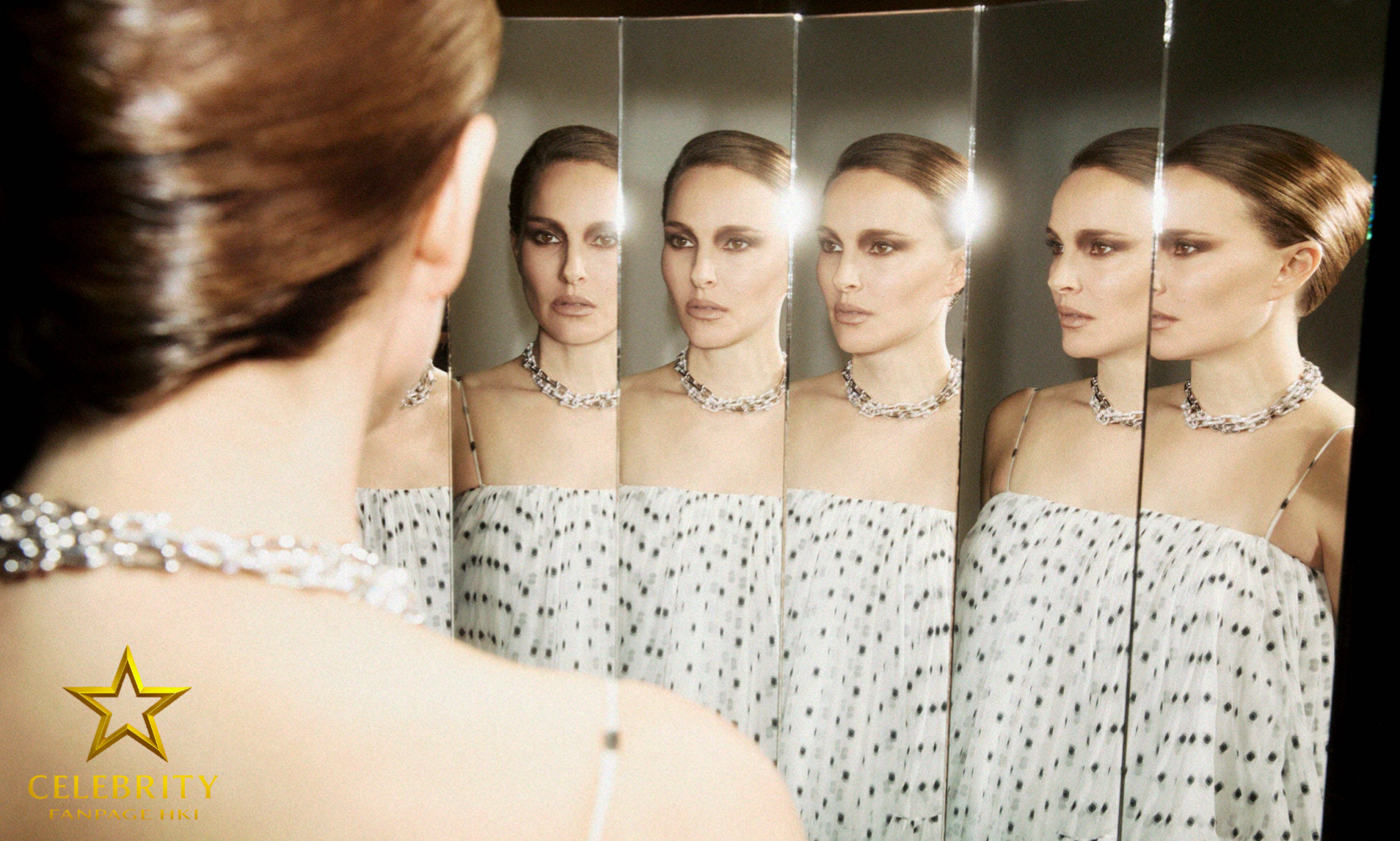
Dress, Dior. HardWear necklaces, Tiffany & Co.
This story appears in the October issue of Harper’s Bazaar.
Hair: Olivier Schawalder for Dyson; makeup: Lucy Bridge; manicure: Beatrice Eni for Manucurist; production: PRODN; set design: Hella Keck
Via: Harper’s Bazaar





Publicar comentário