Meryl Streep and Anna Wintour on Power, Fashion, and Acting the Part
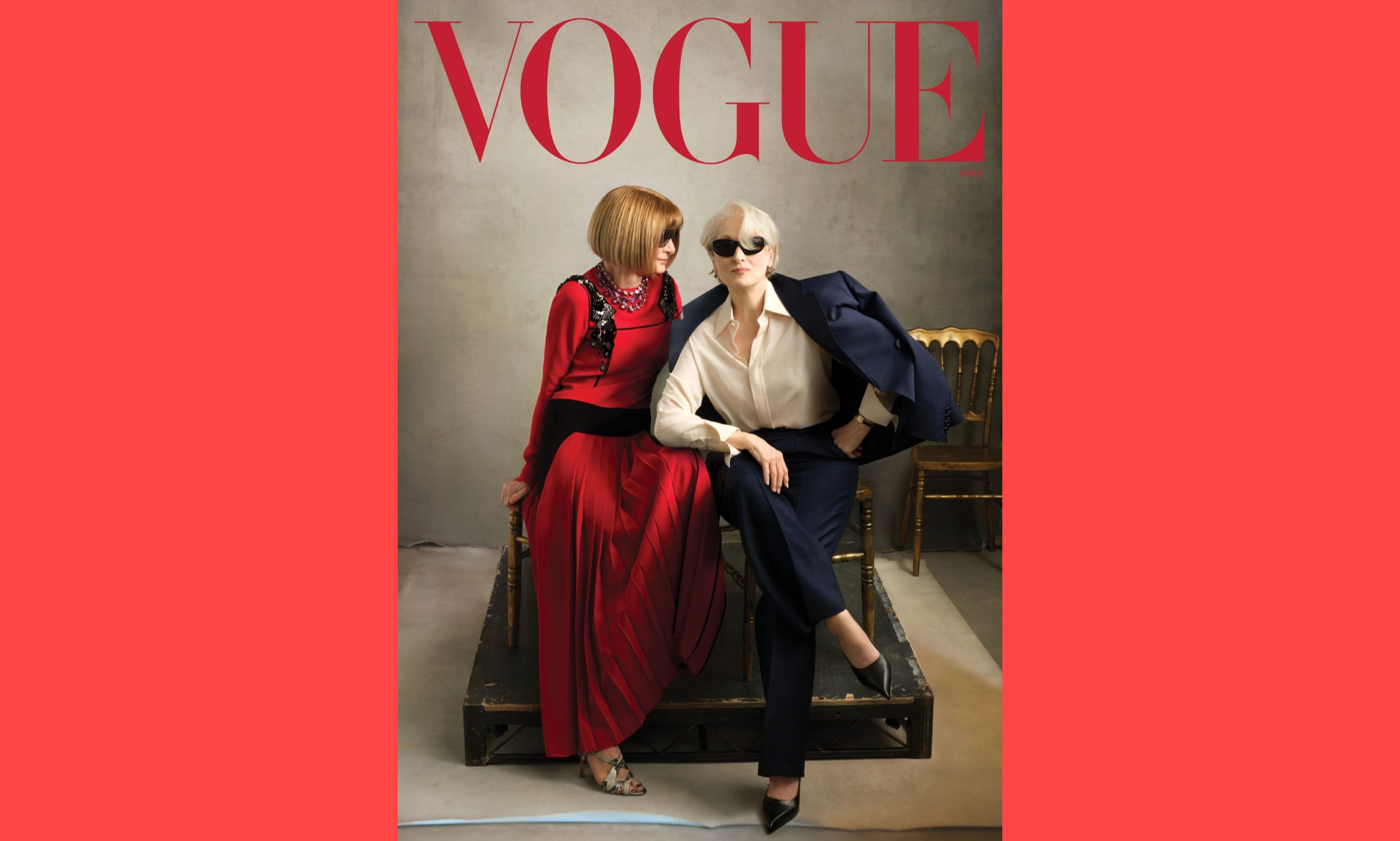

Anna Wintour and Meryl Streep in Prada. Wintour wears Manolo Blahnik shoes, S.J. Phillips necklaces, and Chanel sunglasses. Streep wears Prada sunglasses. For Wintour: hair, Bobby Michael; makeup, Melissa Silver. For Streep: hair and makeup, Donald S Mcinnes. Fashion Editor: Grace Coddington.Photographed by Annie Leibovitz. Vogue, May 2026.
Both Meryl and Anna arrive in yellow scarves, like a pair of generals in matching epaulets. We’re in a sprawling suite at the Crosby Street Hotel, and the occasion is a conversation with a timely premise: What happens when you put two Mirandas in a room? The filmmaker Greta Gerwig, who directed Meryl in 2019’s Little Women, is here too. As an avowed fan of the Devil Wears Prada films—DWP2 (as it’s known at Vogue) opens in theaters on May 1—she has kindly offered to act as moderator. My role is something akin to court stenographer.
The suite’s jaunty decor matches Meryl’s gauzy, sunny pashmina. Anna’s is more egg yolk in color and of a thicker, fringed cashmere. They catch up like old friends, discussing theater outings, politics, parenting, and grandparenting. Greta describes the emotional whiplash of returning home to young children after months away on set filming her forthcoming Narnia film (“They punished me on FaceTime,” she says, and Meryl nods knowingly). The winter temperatures outside are record-breaking; inside it feels almost cozy.
But time is of the essence. This encounter is the result of months of planning and not a small bit of arm-twisting, and it was combined with a remarkable shoot: Annie Leibovitz photographing Anna and Meryl with Grace Coddington acting as stylist (a power quartet if I’ve ever heard of one).
Below is a lightly edited version of the conversation that followed. Meryl and Anna began, naturally enough, by talking about coats, which are something of a motif in the first film. (Who can forget the parade of them flung on the assistant’s desk? Though for the record, I have only seen Anna politely hand hers off.) “I like coats,” Meryl said. “They cover all the sins of whatever else is underneath.”
“And they’re easy to try on,” Anna said.
It proceeded swiftly from there.

Streep in a Dolce & Gabbana coat, Loro Piana pants, and Prada shoes and sunglasses. Wintour in a Chanel coat, brooch, sunglasses, and dress, and Manolo Blahnik boots.Photographed by Annie Leibovitz. Vogue, May 2026.
Greta Gerwig: The question of how you present yourself is so much what The Devil Wears Prada is about. For men, there’s a clear code: You dress for the job you want. But for women, dressing has always been more nebulous. Anna, how much do you think about that? Do you think about how women are meant to dress to communicate power?
Anna Wintour: I don’t think wearing a power suit to the office is in any way necessary. Think about the women that one admires: Mrs. Obama comes to mind. Whether she’s wearing J.Crew or Duro Olowu or Matthieu Blazy’s Chanel, she always looks like herself. I’m full of admiration for New York City’s new first lady because she looks so cool and wears a lot of vintage—young and modern and also entirely herself. To be fair, Melania Trump also always looks like herself when she dresses.
Meryl Streep: I have so many thoughts about this. I think the most…powerful message that our current first lady sent was in the coat that said “I Really Don’t Care, Do U?” when she was going to see migrant children who were incarcerated. All dress is about expressing yourself, but we’re also subject to larger historical and political sweeps of expectation. I’m stunned at how women in power have to have bare arms on television while men are covered in shirts and ties or a suit. There’s an apology built into women. They have to show their smallness. It’s compensatory: The advancements of women in the second half of the 20th century and the beginning of this one have been destabilizing. It’s as if women have to say, “I’m little. I can’t walk in these shoes. I can’t run. I’m bare, not threatening.”
Gerwig: Meryl, you and I were talking about women in films, and the great parts women have had—like Bette Davis or Rosalind Russell. Even at a moment in America when there weren’t many women with full careers, the roles for women were terrific. And you said, “Yes, well that’s because there was no actual threat of Rosalind Russell taking Cary Grant’s job.”
Streep: Or Spencer Tracy’s. So it was fun. It was like cross-dressing.
Gerwig: Women didn’t actually present a threat, so we could be big and outrageous in films—
Streep: We could be brassy and smoke and be tough.
Gerwig: What I think is interesting here is that the character of Miranda Priestly is the sort of outsize role that Bette Davis would be allowed to have.
Streep: Absolutely. Unapologetic.
Gerwig: I wondered if that was why you decided, 20 years later, to go back. Was it watching the world turn and thinking, What do we need from Miranda now?
Streep: I was interested in the business part of it, that thing of carrying the weight of many, many people’s jobs, running a big organization, keeping it going somehow. With this one, I thought, Well, where are they going to go? Now that everything’s disintegrating, now that these institutions are being undermined or exploded in a way that who knows what is happening in the world right now—I wondered what they were going to do. And I do think they’ve located something true about the business now.

“I did think honestly about Anna and tried to imagine what it was like to carry her responsibility and to be as interested in the world and curious as she must have to be,” said Streep of building the character of Miranda Priestly in The Devil Wears Prada.Photographed by Annie Leibovitz. Vogue, May 2026.
Wintour: What I liked about the first film is that it showed the world what a huge business fashion is. It’s a true economic force globally, and the first film acknowledged that. So much has changed. But I like to think we’re evolving rather than disintegrating. We are still here. We’re all doing our jobs—in different ways and across multiple platforms instead of just one, but how wonderful is that? We’re reaching far more people.
Streep: Oh, I didn’t mean disintegrating!
Wintour: When I heard rumors that this new film might be happening, I called Meryl to ask if it was true. I knew she would tell me if it was going to be all right. She hadn’t yet read the script, so she said she’d call me back. And that’s what she did. She read the script. She called me back and said, “Anna, I think it’s going to be all right.” She told me very little about what happens in the film, but I trusted her implicitly.
“With this one, I thought, Well, where are they going to go?” says Streep of The Devil Wears Prada 2. “And I do think they’ve located something true about the business now”
Gerwig: Here’s another thing that’s changed: Fashion used to be thought of as elitist. Why was it seen that way?
Wintour: Maybe because many, many decades ago we were living in the world of haute couture and very expensive fashion only being available to a small group of society women. Today fashion is so much more democratic, and its influence is enormous. It’s central to the culture. Look at how interested people are in what the characters are wearing in Wuthering Heights or Euphoria. Look at the big companies hiring great designers—like Zara signing John Galliano as a creative partner. Or Gap bringing on Zac Posen. Coach hiring Stuart Vevers. Uniqlo working with Jonathan Anderson and Clare Waight Keller. It’s happening everywhere. This is a very changed landscape.
Gerwig: I would love for you both to just speak about being 76. I’m in my early 40s and I look at both of you and I think, That is worth going for.
Wintour: And we’re being photographed by a 76-year-old woman!
Streep: My life…I can’t even speak about that. That question is too huge. In terms of Miranda, and coming back to that character 20 years later, I did think honestly about Anna and tried to imagine what it was like to carry her responsibility and to be as interested in the world and curious as she must have to be. That’s the key, I think, to being alive: Always breaking new water. Always breaking the waves. And we’re not done yet. But the thing that’s fun about this character is that I was using my role models, different people that I know, and most of them are men. So that gave me some freedom too.

“I’d like to say it’s such an honor to be played by Meryl, however distant Miranda is from myself,” says Wintour, here seen in a still from Vogue’s cover video, directed by Nina Ljeti.
Wintour: First of all, I’d like to say it’s such an honor to be played by Meryl, however distant Miranda is from myself. Who wouldn’t think that that wasn’t the most extraordinary gift? I like my age. I feel as alive, excited, and aware as ever, and I like to learn from my children and from all my teams around the world. It’s always exciting. And I think with experience, you have a sense of balance and proportion, and you know that life is not perfect and that things will go wrong and you’re just going to give it your best shot. But if it doesn’t work, you have to move on. I feel age is actually an advantage.
Streep: Yes.
Wintour: I think with a life well lived, you can lead more easily.
Gerwig: I can definitely say that from being on set with Meryl, everybody sits up a little straighter when you’re there.
Streep: That’s ridiculous.
Gerwig: No, it’s true. I watched it happen when we did Little Women together, and you were in costume and you sat in for your own lighting, and that was the fastest they’ve ever lit anything. It was just: Meryl is sitting in for her lighting. I don’t know if fashion and publishing feel this way, but I deeply feel that filmmaking is passed from person to person. Meryl, you’ve experienced that—and some of the people you’ve walked this path with are not here. Mike [Nichols] is not here, and Robert [Redford].
Streep: Mike’s here. [Touches her chest.] Mike is so here. That’s the great consolation of getting older. It’s unbearable when every week somebody’s dying that I love, but you realize, Okay, you’ve got to swallow her. You’ve got to swallow him. You’ve got to have all of them. They are in here, you’re going to use them, and they’re going to live. The indelible people don’t go. We don’t lose people. We keep them and they keep working.
Gerwig: Anna, do you feel that same thing of something being passed on, or a connection to different designers or people who are gone?
Wintour: Well, of course, Vogue is built on the values and the traditions of its history. I had the great good fortune to work for both Alexander Liberman and Si Newhouse, and they were extraordinary men with fantastic instincts. I do think you should stay grounded in your past. When you understand your history, that’s when you can move forward.

“I would dread the shoes. Every day, wow, to pull it together,” says Streep at the prospect of (actually) having Wintour’s job.
Streep: Do you see that anyone will have a career like Karl Lagerfeld’s—
Wintour: Yes!
Streep: That same longevity and influence?
Wintour: I do, I really do. I feel Matthieu has found the job of his dreams. The owners of Chanel—Alain and Gérard Wertheimer—are very patient. And they’ve always found that balance between tradition and an openness to change. That was the magic of Karl, who knew history so completely but also had curiosity and restlessness and was an extraordinary multitasker. I think Matthieu has the same vitality and cultural awareness and could be—who knows?—there as long as Karl.
Gerwig: There’s always the question, especially with women, of children and work and how that goes together. And I got very excited thinking of interviewing you because nobody asks about being a grandmother. So, I mean, Meryl, I know you are incredibly involved—
Streep: Some say over-involved.
Gerwig: How does being a grandmother balance with work?
Streep: It’s just grabbing seconds, just grabbing everything you can of them, with the knowledge of how completely fleeting it all is and how rapidly time goes. This is what my mother said to me, and I said, “Yeah, yeah.” It’s the longest, shortest time. And you can’t get anything back. So take as much as you can…. I find it divine. I have six grandchildren, six under six. They’re six, five, four, three, two, and one. I hope we’re not done, but we’ll see. I can’t even talk about how much it means to me that my kids give me as much time as they do with their kids. The only thing is that they’re on two coasts, so I’m in the airplane a lot.
Gerwig: And you, Anna, also have grandchildren.
Wintour: I don’t have as many as Meryl. I only have four, and I have four step-grandchildren that grew up all around us. Being a mother when you have the jobs that we have—you have to make the time. I was relentless about going to the games and turning up at the parent-teacher meetings, being there when it was important. I felt like Vogue could always wait and that it’s okay to be a busy mother. You make it work. We have a family compound on Long Island, and I try to make it a center for all of us, who are spread all over the world. We love to celebrate birthdays and weddings; traditions are important—we’re English, so we constantly play games and stage countless tennis tournaments—and we try to take care of each other through thick and thin. I try to instill in my children and my grandchildren that it’s family that counts and family who will give you love and support. If you have that, everything else will be fine.
Gerwig: Meryl, you said something to me that has rattled around in my head. You said, “Life begins when you make a commitment,” and I thought that that was such a wise thing to say. Obviously when you have a family that’s the biggest commitment, but I think for both of you in your work, you’ve made a commitment to your respective fields.
Streep: Tom Stoppard said, “You’ve got to shift your weight.” You’re always, always on unstable ground. It’s so uncertain being an actor. You’re chronically unemployed. And then there’s no sort of climb, because fame is something you have in a second. But to make a body of work and have faith in yourself? That takes time, and you can’t do it at home by yourself—it’s not like writing or composing. I don’t think: I love this job. I’m going to have this job for a long time. I think: This is the world. The unstable world. Everything changes and it’s about learning to sort of be prepared for that.
“When I heard rumors that this new film might be happening, I called Meryl to ask if it was true,” says Wintour. “I knew she would tell me if it was going to be all right”
Wintour: But I also think challenges are really what makes what one does interesting. During COVID we had to totally change how we worked, how we communicated—everything. I thought all the time of my son, Charlie, who was a resident at Cornell. He was working in the COVID wards and because his field is mental health, a part of what he had to do was to break tragic news to families when they had lost someone. We were all holed up out in the country, and he would come home every weekend and had to descrub and then he would reach for his children and just hold onto them. That for me was context—an important reminder of what was happening in the world even as I was trying to lead these global teams through uncharted waters. What do you do? You find a way.
Gerwig: If you had her job, and you had her job, what is the thing that would be most exciting and what would be the thing that you would think, I can’t do that.
Wintour: There’s no way. I have no gifts. I have absolutely no gifts at all. I can’t sing, I can’t dance, I can’t act, I’m useless with my hands, I can’t cook, I certainly can’t sew.
Streep: You run a multinational corporation, that’s all…. I would dread the shoes. Every day, wow, to pull it together. But working with a lot of young people would be thrilling, and to keep all the ideas flowing—I love that kind of engagement—and also just to be creating something that makes people happy. To find beauty. Look for it, nurture it. Support it. That’s a good thing.
Gerwig: And now I’ll just ask one sort of fandom Miranda question. Has her style changed?
Streep: Well, everybody was afraid of Anna on the first one, so we couldn’t find any clothes. Nobody would give us any clothes. This time we pared her down. We made her simpler and just more essentially her. And we do have less hair with me—so that was not as floppy and floopy. She loves an accessory, but there’s a fearless thing with her. Less worried about what anybody thinks.
Gerwig: Did you want to say which is your favorite costume?
Wintour: Oh, the red dress, the Jezebel dress. Pierpaolo!
Streep: Pierpaolo. That he would make that.
Wintour: It’s a great dress. You look amazing in it. What’s the film in which your costumes have been your favorite? I know mine is Out of Africa.
Streep: I don’t know. There were so many great people I’ve worked with. I liked Florence Foster Jenkins because I love a big bosom and they knew how to dress a big bosom at a certain time. Costume is character. When I was at Vassar, that was my degree, in costume design, because I’m a good sewer and I really love drawing. For my thesis I designed 60 costumes for Camino Real—you know, the Tennessee Williams play. And all those characters are so vivid. They’re so idiosyncratic and weird. All my life I’ve thought I’ve been such a pain in the ass for whomever is the costume designer. Because I have such little nitpicky ideas.
Read Vogue’s May 2026 Editor’s Letter here.
Gerwig: Meryl, you said this thing about the first movie and how you loved being with everyone on set—with Anne and Emily and Stanley—but that you felt as if you couldn’t quite hang out with them the way that they could hang out with each other.
Streep: Oh, they all had a fabulous time. And I felt like I had to have some distance. I do like a hang, I mean, that’s almost how you pick the things, like, How good is the hang going to be? But I really consciously pulled back, and I was sitting in my trailer just miserable the whole time.
Wintour: What did you read when you were in the trailer?
Streep: I didn’t read. I knitted. I’m still knitting. But I can’t read anything when I’m working because it splits my focus. Especially with this character who has a sort of relentless energy.
Gerwig: When we had a wrap party for Narnia, I realized nobody wanted me there. I was like, Nobody can have any fun as long as I’m there.
Wintour: I know that feeling.
Gerwig: So when I embraced the last crying child, who was sad that the movie was over, I was like, “I’m going to take myself home.” And I almost felt like, as I walked out the door, everyone was like, “Yay.”
Wintour: The art of the drop-by is also good. You go for five minutes and head for the hills.
Gerwig: You want to tell us the plot of the movie?
Streep: That’s, like, the last thing I ever remember about a movie. I am the best audience for my own movies because I never remember what happened.
Wintour: Let’s hope it’s a happy ending.
Streep: Yes, it’s a happy ending. Or not happy, exactly. But it’s real and it’s triumphant.
Wintour: Can’t wait.
In this story: For Wintour: hair, Bobby Michael; makeup, Melissa Silver. For Streep: hair and makeup, Donald S Mcinnes. Tailor: Bill Bull.
Produced by AL Studio. Set Design: Mary Howard.
Via: Vogue




Publicar comentário